
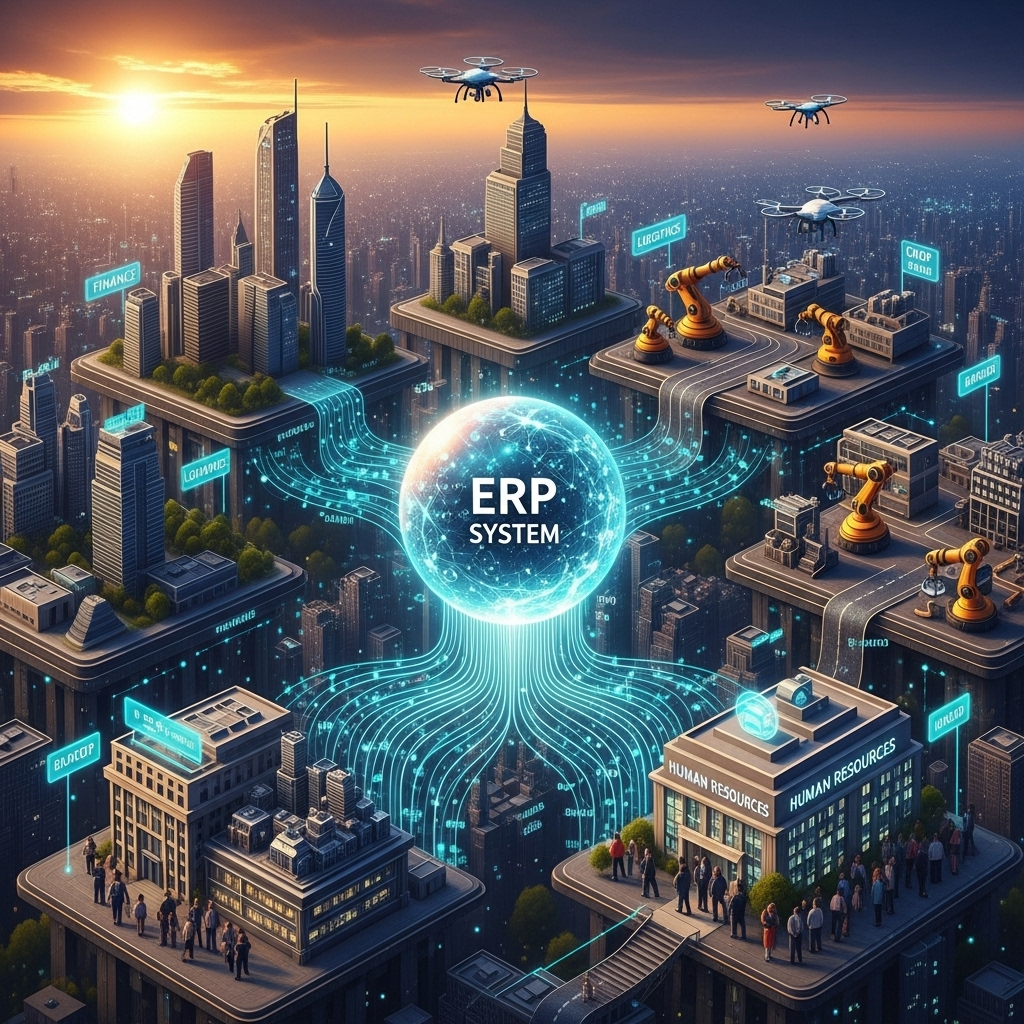
An Enterprise Resource Planning (ERP) system is a comprehensive software application designed to integrate and manage all aspects of a business. It acts as the digital backbone of modern organizations, centralizing various facets of operations to achieve enhanced efficiency, informed decision-making, and sustainable growth.

What an ERP system entails?
Core Function:
An ERP system aims to streamline and automate business processes, provide a single source of truth, and offer complete visibility into every business area. It allows different business units to communicate with each other, integrating them into a single information system.
Unified Data Platform:
- A key feature is its uniform, centralized database, which ensures a "single version of the truth" and eliminates misinformation across departments. This means data collected by one department is instantly available to anyone who needs it in any other department, preventing data silos and promoting cross-functional communication and transparency.
Integration and Modules:
- ERP systems integrate various business processes, from production and inventory management to supply chain coordination and beyond. They are an "umbrella" that houses various modules, each supporting a specific business function such as finance, accounting, HR, sales, purchasing, and inventory. Businesses can select and combine modules based on their specific requirements and add more as they grow, thanks to a plug-and-play model.

Key Features:
- ERP systems typically offer a wide range of features categorized by use case, including:
- ◦ Financial Management: General ledger, accounts payable/receivable, financial reporting, payroll, tax management, financial analytics, forecasting, and reporting.
- ◦ Inventory and Warehousing: Real-time tracking of raw materials, work-in-progress, and finished goods, automated reordering, stock replenishment, and multi-location functionality.
- ◦ Supply Chain Management: Procurement, demand forecasting, supplier collaboration, order fulfillment, and tracking product movement.
- ◦ Production Monitoring and Work Order Automation: Real-time updates on production status, resource allocation, quality control, and automated generation and scheduling of work orders.
- ◦ Human Resources Management (HRM): Employee attendance, payroll, skills tracking, and management of employee information.
- ◦ Sales and Marketing: Client communication, forecasting, customer acquisition cost reporting, lead generation, and marketing automation.
- ◦ Business Intelligence and Analytics: Data visualization, trend analysis, predictive analytics, and real-time Key Performance Indicator (KPI) tracking for informed decision-making.
Benefits:
- Implementing an ERP system leads to significant advantages, such as:
- ◦ Enhanced Operational Efficiency and Cost Reduction: By automating routine tasks, optimizing resource allocation, and reducing manual errors.
- ◦ Improved Data Accuracy and Integrity: Through a centralized database, ensuring reliable reporting and analysis.
- ◦ Better Financial Decision-Making: Providing real-time insights and comprehensive reporting.
- ◦ Increased Productivity: By streamlining workflows, improving workforce management, and fostering continuous improvement.
- ◦ Accelerated Time-to-Market: Through product lifecycle management (PLM), rapid prototyping, and efficient project management.
- ◦ Ensuring Compliance and Regulation Adherence: With features for regulatory reporting and detailed audit trails.
- ◦ Scalability and Flexibility: Designed to grow with a business, accommodating more users and resources, and often supporting multi-currency, multi-language, and global operations.
Deployment Models:
- ERP systems can be deployed in various ways to suit different business needs and resources:
- ◦ On-premise ERP: Installed locally on company servers, offering total control over the system and data, but requiring substantial initial investment and dedicated IT for maintenance.
- ◦ Cloud ERP (SaaS): Hosted on remote servers and accessed via the internet, typically involving lower upfront costs, automatic updates, and enhanced accessibility and scalability.
- ◦ Hybrid ERP: Combines elements of both on-premise and cloud deployments, providing flexibility, often seen in "two-tier ERP" where a legacy system at headquarters is integrated with cloud solutions for subsidiaries.
In essence, an ERP system goes beyond basic accounting software by integrating various business functions into a single, cohesive platform, providing a holistic view of the organization's operations.