
This is to summarizes the main themes, key ideas, and important facts regarding the application of Artificial Intelligence (AI) in digital marketing, drawing from the provided sources. It aims to provide a comprehensive overview of AI's transformative impact, its practical applications, and best practices for implementation.
Executive Summary
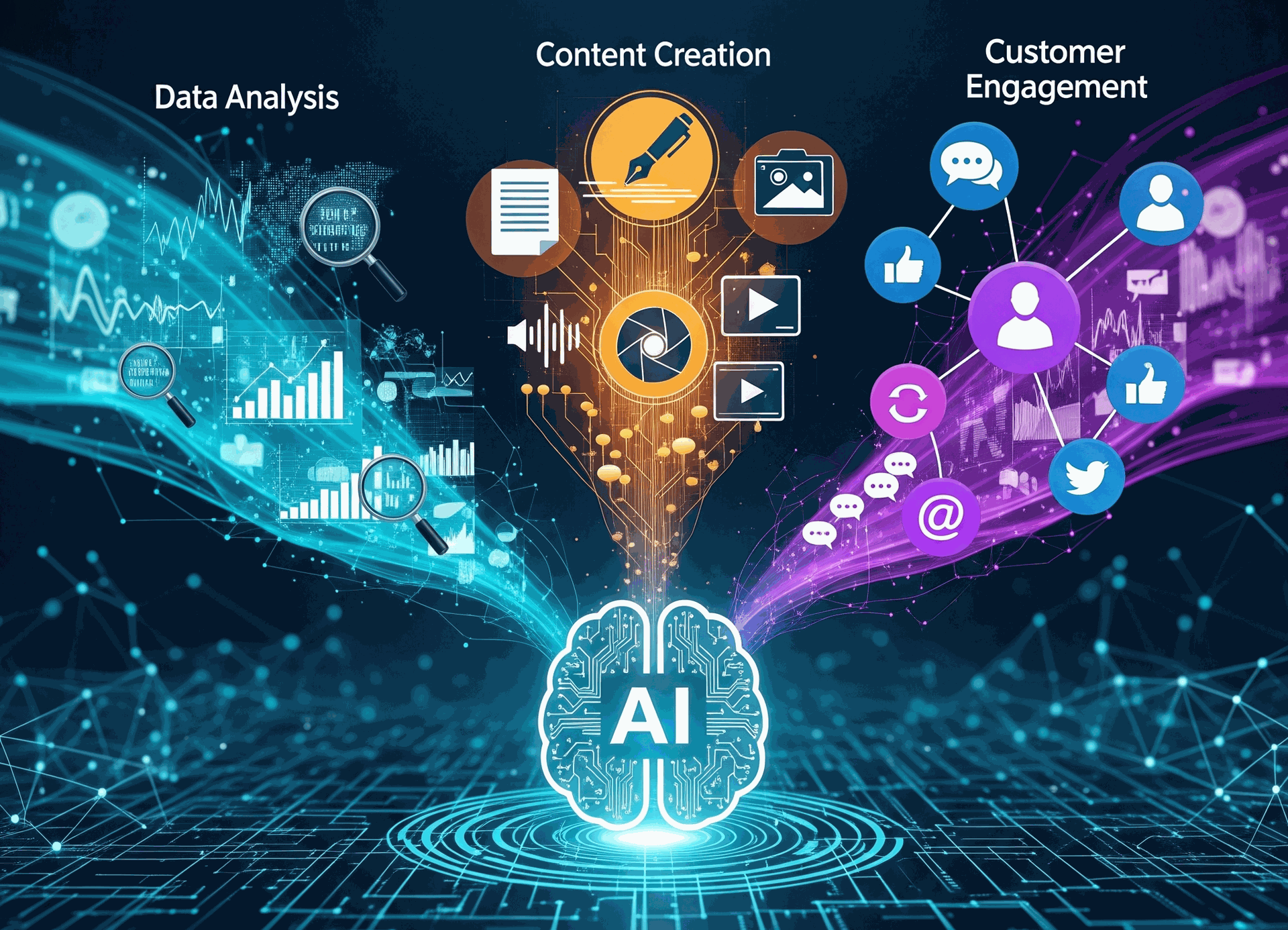
AI is rapidly reshaping digital marketing, moving beyond a "buzzword" to become a "game-changer" that offers a "significant competitive edge." It is not intended to "replace marketers—it's here to empower them," acting as a "powerful toolkit that amplifies human creativity and analytical rigor." The core benefits revolve around automation, personalization, predictive analytics, and enhanced efficiency, leading to "smarter, faster growth" and improved ROI. Marketers can leverage AI across various functions, from content creation to advertising optimization, but successful implementation requires a "human in the loop" approach, data hygiene, and a focus on measurable impact.
Main Themes and Key Insights
1. AI as an Enabler of Efficiency and Automation: AI excels at automating "repetitive tasks," freeing up marketers to focus on "strategy and creativity." This includes:
- Content Generation: AI tools like ChatGPT, Jasper, and Copy.ai can "write blog posts, emails, and social media captions," "generate ad copy in seconds," and "repurpose content." This leads to "50% faster rollout" for content creation.
- Campaign Management: AI can "automate email sequences, social media posting, and ad campaign adjustments," as well as "data analysis and reporting," streamlining operations and "reducing bias."
- Customer Service: Chatbots and virtual assistants offer "24/7 customer service and lead generation without human involvement," answering "FAQs instantly" and qualifying leads.
2. Hyper-Personalization at Scale: One of AI's most impactful contributions is its ability to deliver "hyper-personalization" by analyzing "vast amounts of data to understand individual customer preferences, browsing history, purchase patterns, and even emotional sentiment."
- Tailored Content: AI facilitates "personalized product recommendations, blog posts, or email offers that resonate with each individual," increasing conversions and customer loyalty.
- Dynamic Experiences: Websites can adapt "layouts, calls-to-action, and messaging based on user behavior in real-time."
- Audience Segmentation: AI can "segment audiences more effectively," identifying "nuanced behavior patterns and interests" for highly targeted campaigns.
3. Predictive Analytics for Smarter Decision-Making: AI's capability to "identify patterns and predict future outcomes is a game-changer." It allows marketers to be "one step ahead" by:
- Forecasting Behavior: Predicting "which customers are likely to churn, what products they might be interested in next, or when they are most likely to convert."
- Optimizing Spend: Helping to "optimize ad spend," "adjust bids automatically," and "forecast sales," leading to "real time insights, automated updates, and data driven budget shifts."
- Anticipating Trends: Gaining "insights into emerging trends and consumer demands," enabling proactive strategy adaptation.
4. Revolutionizing Advertising and SEO: AI significantly enhances paid advertising and search engine optimization (SEO) efforts.
- Smarter Advertising: Platforms like Meta Ads and Google Ads use AI to "predicting which audiences are most likely to convert," "adjusting bids automatically," and "testing different creatives and formats," leading to "maximum ROI." This is often facilitated by "Programmatic Advertising."
- SEO Optimization: AI tools help marketers "find relevant keywords," "optimize content for search engines," and "analyze competitors," leading to higher rankings on Google.
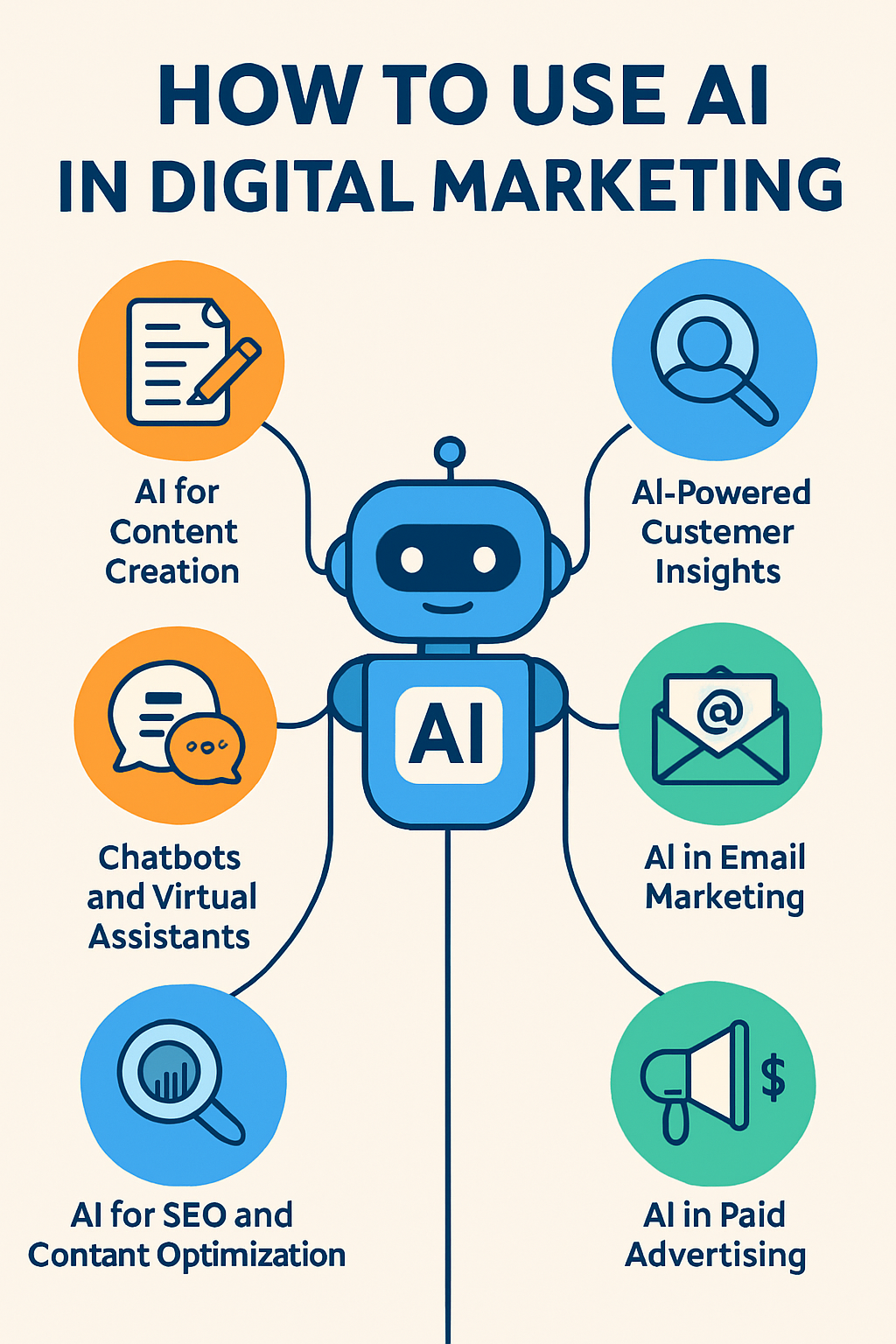
5. Core AI Capabilities and Tools: Several AI capabilities are central to its application in digital marketing:
- Natural Language Generation (NLG): Creates "human like copy automatically" (e.g., ChatGPT, Jasper, Copy.ai, Writesonic).
- Image/Video Generation: Produces "visuals from text prompts" (e.g., Pictory, Lumen5).
- Predictive Analytics: Forecasts trends and customer value (e.g., Google Analytics 4, HubSpot, Mixpanel, IBM Watson, Adobe Analytics).
- Chatbots & Conversational AI: Handles customer queries and lead qualification (e.g., ManyChat, Drift, Tidio, Intercom).
- Personalization Engines: Tailors content based on user behavior (e.g., Mailchimp, Klaviyo, ActiveCampaign, Optimizely, Dynamic Yield).
- SEO & Content Optimization Tools: Suggests keywords and content improvements (e.g., Surfer SEO, Clearscope, MarketMuse).
6. Implementation Strategy: Start Small and Iterate: Integrating AI does not require a "complete overhaul." The recommended approach is to:
- Identify repetitive tasks or specific marketing challenges.
- Start small and experiment with a single tool or a pilot on "one email list or a single landing page."
- Maintain "Human in the Loop (HITL)": AI can produce errors or bias; therefore, "always review and edit for quality and brand voice," defining "validation checkpoints: copy review, brand voice audit."
- Prioritize Data Hygiene: "AI is only as good as the data fed," necessitating regular auditing of customer segments and removal of duplicates.
- Measure Impact: Focus on "measurable lift," tracking "cost per lead, revenue attribution, LTV uplift," rather than just vanity metrics.
- Stay Updated: AI models "improve rapidly," requiring marketers to "subscribe to AI newsletters, attend webinars."
7. Real-World Impact: Case studies demonstrate tangible results from AI adoption:
- Zendesk: Achieved "60% faster response, +30% CSAT" using a GPT-4 powered chatbot.
- HubSpot: Saw a "12% lift in form completion" with AI-generated dynamic headlines.
- Coca-Cola: Achieved "50% faster rollout, viral social reach" with AI for quick video creation.
- IBM Watson: Reduced downtime by "18%" using Vertex AI for anomaly detection.
Conclusion
AI is "no longer optional—it’s a necessity for staying competitive in digital marketing." By strategically integrating AI tools for automation, personalization, and analytics, businesses can "work smarter, deliver better results, and stay ahead of the competition." The future of marketing is "intelligent," and marketers who embrace this transformation will unlock "new levels of personalization, efficiency, and ultimately, drive greater success for their business."